
Breath of Light: A Philosophical Interpretation by Maria Maragkou
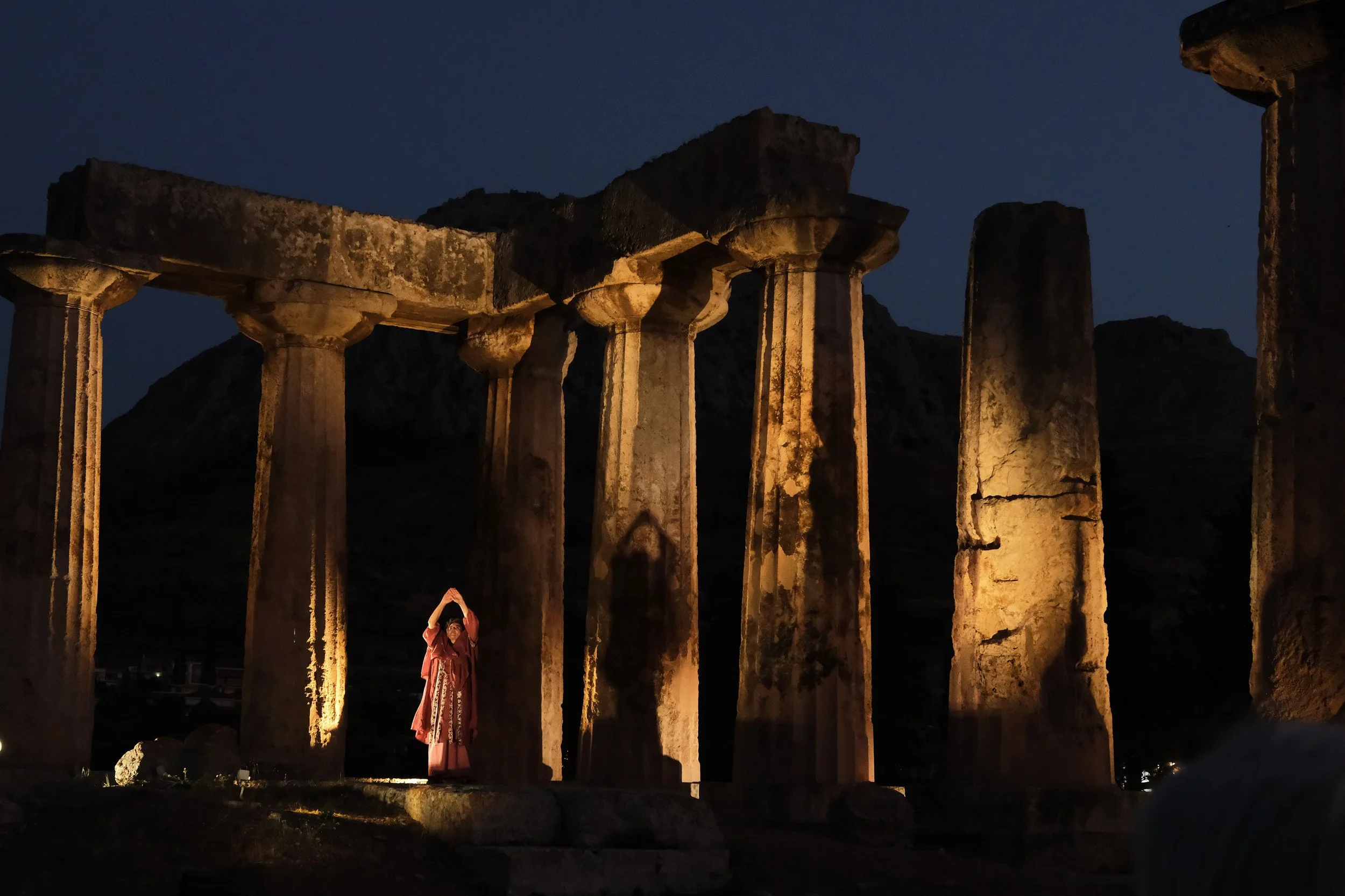
A philosophical interpretation of Breath of Light by Maria Maragkou, illuminating the symbolism of the performance through Ancient Greek philosophy, the Apollonian tradition, and the soul's journey toward remembrance.
The landmark performance Breath of Light, presented at the Temple of Apollo in Ancient Corinth, gave form to the cosmic journey of the soul through a deeply symbolic language, drawing upon the principles of Ancient Greek philosophy and its vision of the cosmos.
The choice of costume played an essential role in conveying this symbolism.
The Human Soul, portrayed by the extraordinary Lydia Koniordou, appeared clothed in crimson chitons, signifying the embodied condition—the soul enclosed within a body, a body that carries blood and belongs to the realm of mortality.
The Luminous Presence (the Light), emerging within the Temple as the sun inclines toward the horizon at sunset, and embodied by the equally remarkable Maria Papageorgiou, is robed in a radiant golden chiton.
She becomes the guide of the Human Soul, leading it out of the chaotic condition into which it has fallen upon entering the realm of generation and decay. She is its solar guide, the Voice of Remembrance, revealing the path by which the soul may rediscover its idion kallos—its own intrinsic beauty—and awaken the white light that dwells within.
White is the defining colour of the garments worn from the very beginning by the five dancers—the Luminous Beings—who embody the divine revolutions with which the soul must once again come into harmony. As the soul seeks to attune its powers to these divine revolutions of the cosmos, from which it was severed upon descending into embodiment, the figures whirl ever faster, expressing the soul's inner ascent.
In the Dictionary of Dimitrakos we find, among other things, that the Greek word λευκός (white) derives from λύκη(light, that which borders darkness), and that the adjective is used primarily to describe the purity and serenity of water. Yet emotion itself belongs to the moist nature, and thus reveals itself through tears. White therefore signifies the purified and tranquil centre of the heart, the very seat of the soul. It denotes the preservation of the purity of one's essence, untouched by the corruption of matter.
Descending from the ethereal realms into matter, the Human Soul loses its measure as it enters the turbulent multitude of birth. Yet Apollo's Delphic injunction remains: "Mēden Agan" — "Nothing in Excess." It is an invitation to rediscover measure (metà horíou), the wisdom of living within the right bounds.
Lost within the restless realm of becoming and decay, the Human Soul dwells among shadows and images that it mistakes for its true self. Within the sacred stillness of the Temple, it seeks communion with its Agathos Daimon, its benevolent guiding spirit, so that it may "breathe again" beyond evil and fulfil the ancient prayer of the initiates of Eleusis:
"May you bring the cycle to its end and breathe free from evil."
(Proclus, Commentary on Plato's Timaeus, 5.297.10)
To this end, Light is invoked through the recitation of the Orphic Hymn to Apollo, the God of Harmonisation, the Unifier who sustains the whole of creation. Performers and audience become attuned through a shared step, a shared breath, a shared rhythm. The illumination of the soul is no longer an individual experience; it becomes a collective act of remembrance as the full moon rises behind the Temple.
The embodied Human Soul (Lydia Koniordou) appears at the Spring of Glauke, where its solitary voice joins the chorus of children, whose singing expresses innocence and purity.
According to the Dictionary of Dimitrakos, glaukos means bright, azure, blue, sea-blue; hence the expression "the glaucous sea." Figuratively, it also describes that which, through its gentle light or colour, awakens serenity within the soul. Thus glaukos evokes both the shimmering blue sea and the tranquil state of feeling that arises when the soul shines with the light of virtue.
The Apollonian Light pours into heart and mind, uniting all souls while dissolving the darkness of ignorance and the weight of negative emotion. It is the Light That Never Sets, weaving every soul into nature and into the living fabric of the cosmos.
The conclusion of the performance is also the completion of the soul's journey—its passage through matter toward illumination and its reintegration into Universal Philotēs, the cosmic bond of love and kinship, proclaiming the ancient truth:
HEN TO PAN — THE ALL IS ONE.
Maria Maragkou
